EAST AND WEST BANK MONITORING

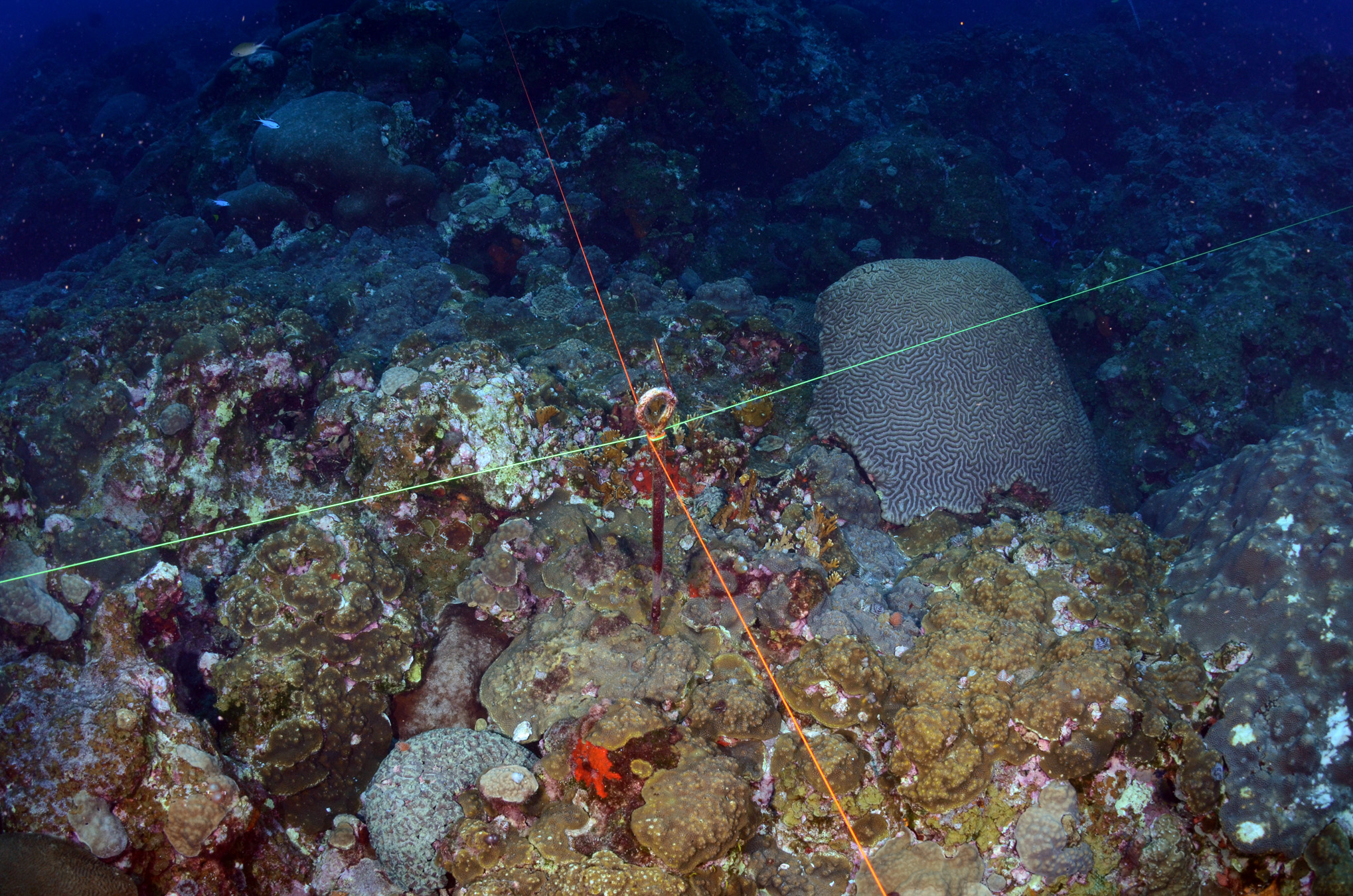
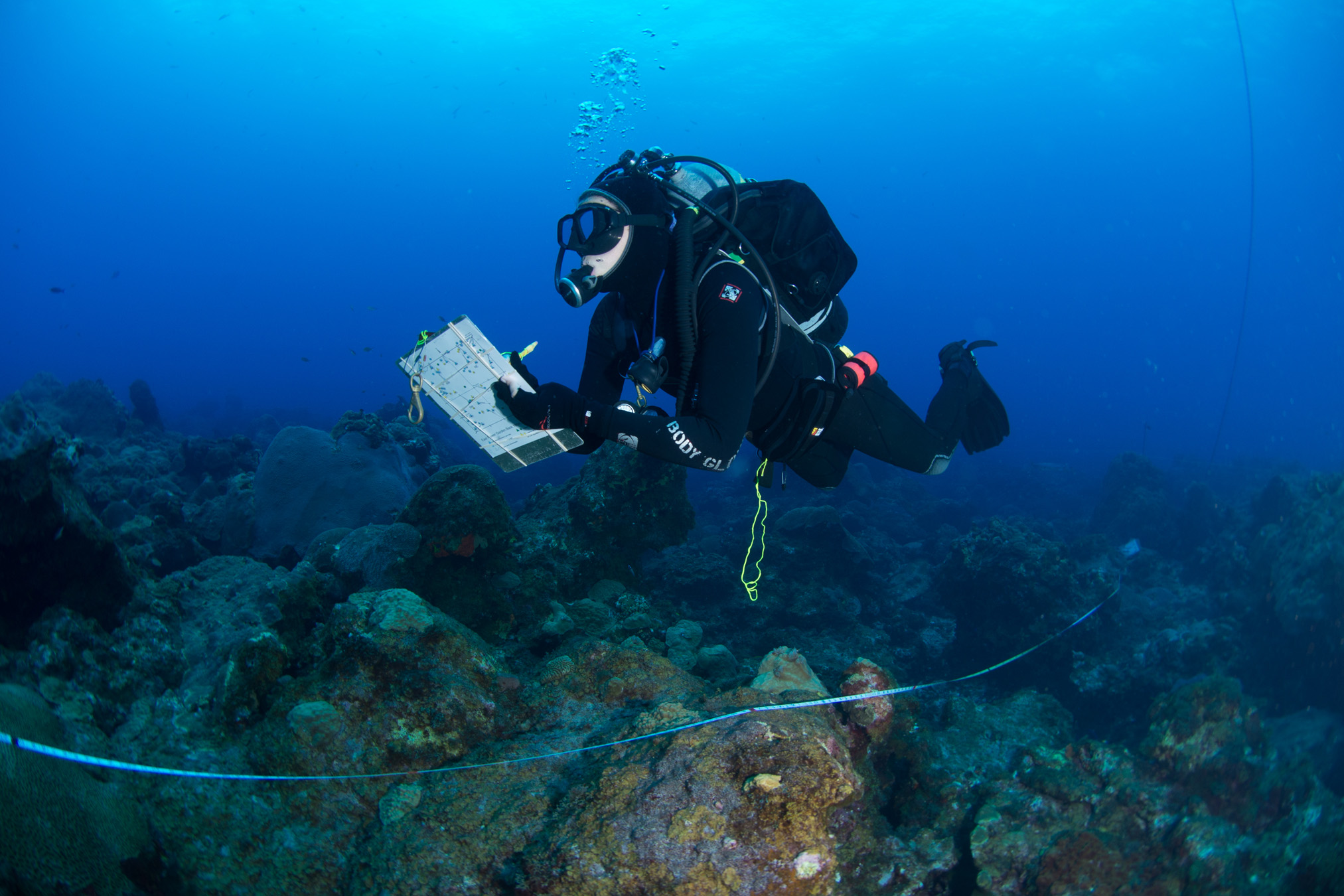
Long-term monitoring efforts at East and West Flower Garden Banks take place in 100 meter square study sites (one at each bank). The study sites are marked out with 100-meter measuring tapes and colored string.
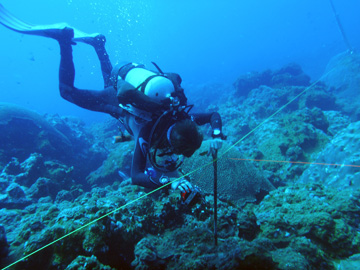
Metal stakes embedded in the reef mark the corners and midpoints of each side of the study areas.
(Image: FGBNMS/Park)
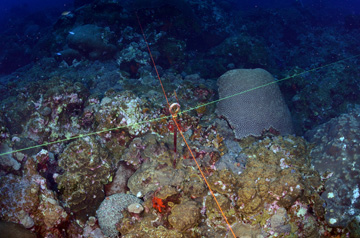
A pin at the center of the study site allows researchers to divide the site into quadrants, which makes it easier to navigate around the site and locate photo stations.
(Image: FGBNMS/Schmahl)
All of the monitoring activities take place within the study site.
Random Transects
Seventeen non-overlapping images are taken along 10-meter transects placed randomly about the reef. These images are later evaluated for benthic cover percentages of coral, algae, sponge and substrate.

Taking photos along a random transect.
(Image: FGBNMS/Hickerson)
Repetitive Photo Stations
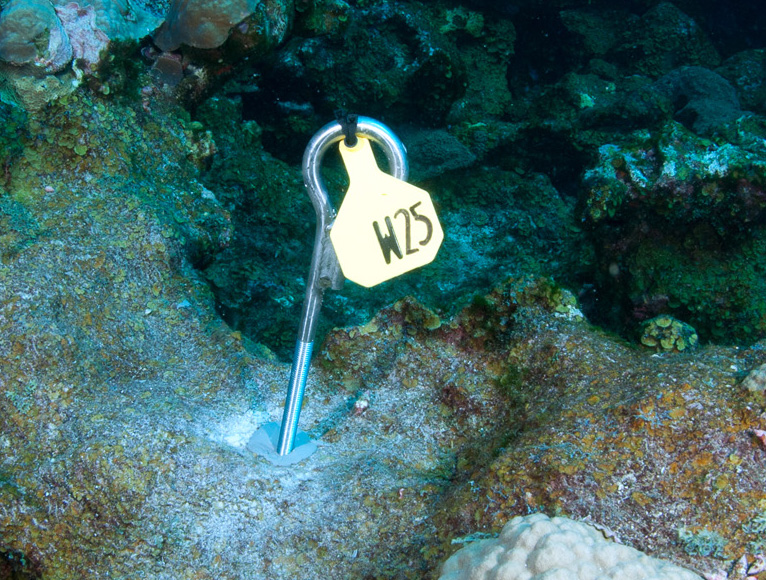
Metal pins placed at various locations around the reef mark stations where comparative photos are taken year after year. Over the years, some stations have gone missing and some new stations have been established, but many of the original stations are still used. Newer pins have been installed, as needed.
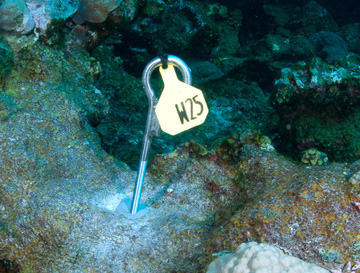
Pin marking a repetitive photo station.
(Image: FGBNMS/Schmahl)
Repetitive photo stations images are taken using a camera mounted on a t-frame. The base of the frame is placed at the pin and oriented so the compass on top is facing north. A level on top of the t-frame helps the photographer get the same angle on the photo from year to year.
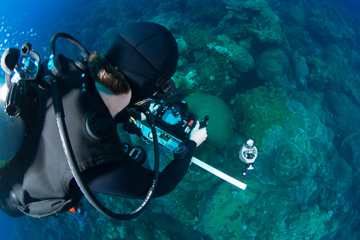
Taking a repetitive photostation image.
(Image: FGBNMS/Schmahl)
Taking the same image in the same way, year after year, provides a time series of specific coral colonies. Click here to see examples of time series from 1989-2014 at East Flower Garden Bank and West Flower Garden Bank.
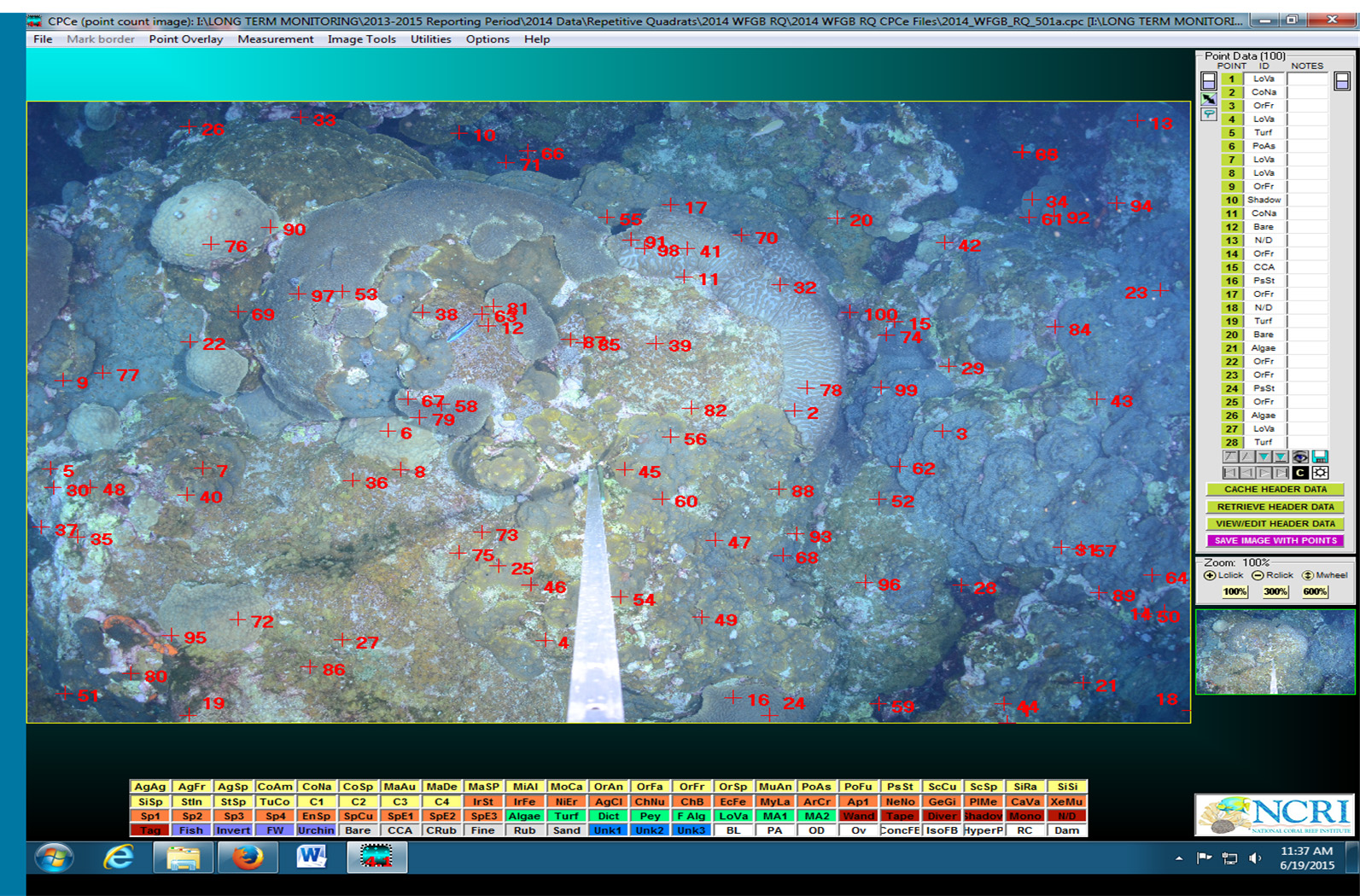
These images are evaluated for benthic cover percentages of coral, algae, sponge and substrate using a Coral Point Count program.
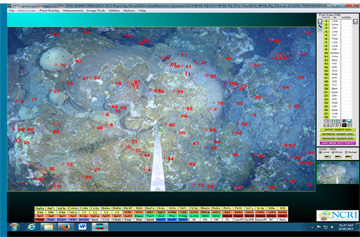
A Coral Point Count program is used to to identify benthic cover down to the species level at 100 random data points, for each image.
Repetitive Lateral Stations
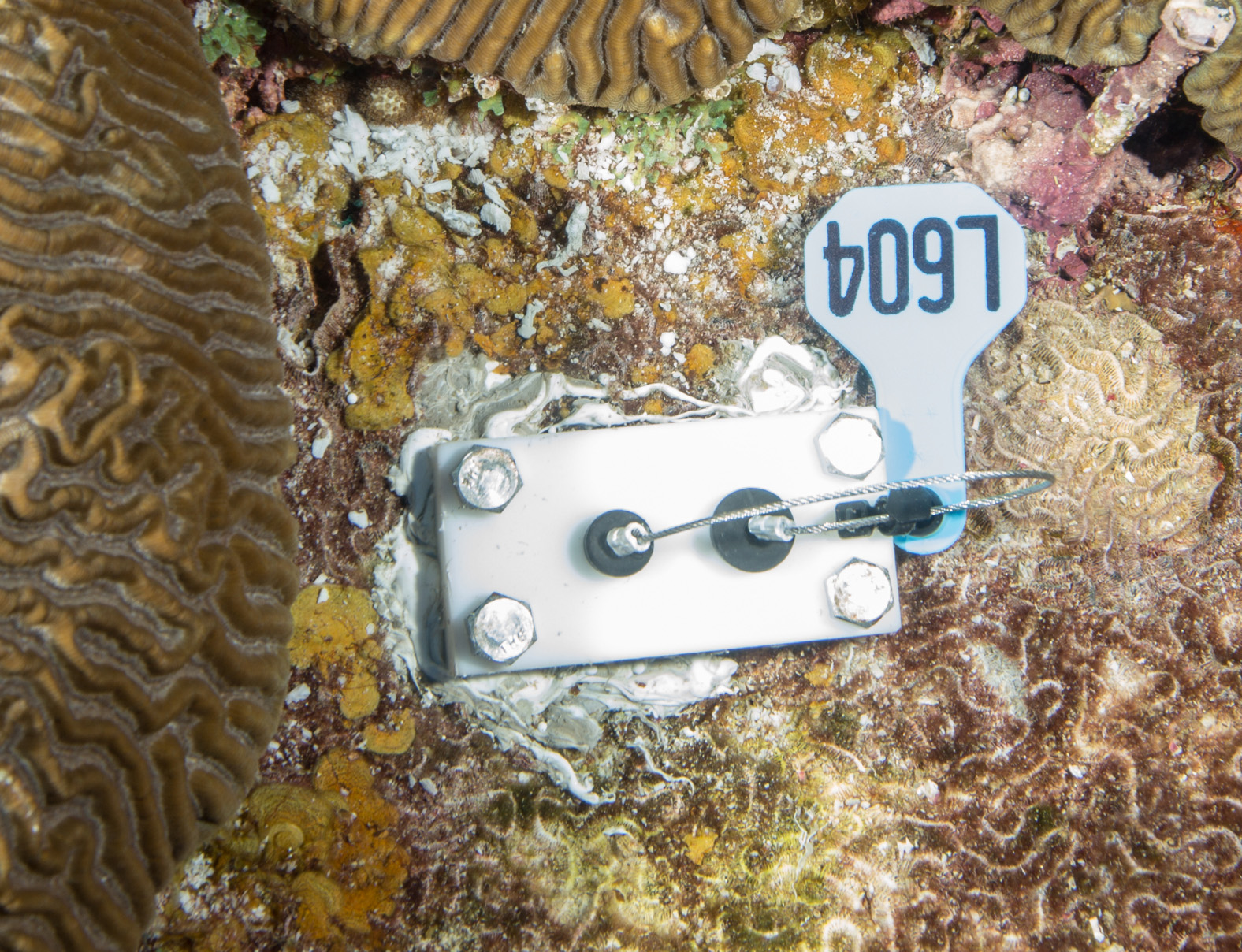
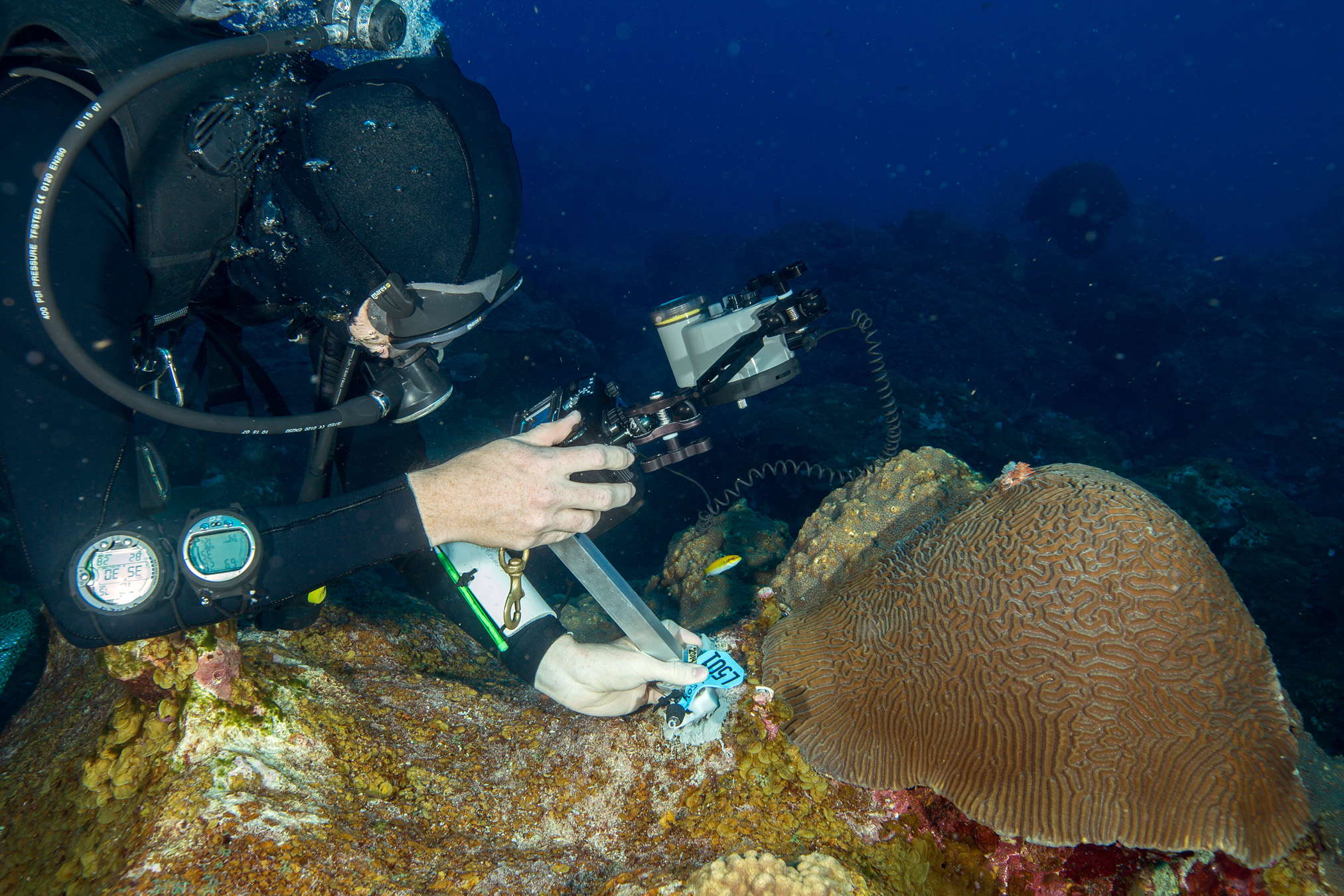
Repetitive lateral growth stations are located near the edges of Pseudodiploria strigosa colonies (brain coral) to capture images of the growing edges.
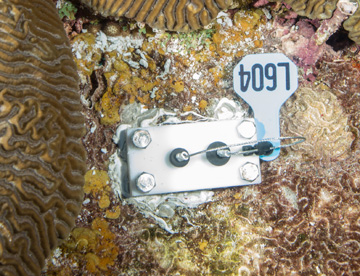
Keyhole template used to line up the camera for images at a lateral growth station. (Image: FGBNMS/Schmahl)
The metal plate marking each station is designed with keyhole notches that the camera frame will fit into to guarantee the correct photo orientation is achieved each year.
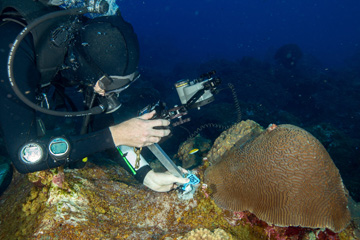
Taking a lateral growth station photo to see how much
a brain coral colony has grown from year to year.
(Image: FGBNMS/Schmahl)
Images from the lateral stations is evaluated for growth, retreat or stasis of the brain coral colonies that are photographed.
Fish Surveys
Bohnsack surveys are conducted to quantify the number, species and size of fish at random locations on the reef.
To conduct these surveys, a diver will first float above a specific point on the reef and gradually rotate for 5 minutes, noting all of the species seen within a 15 meter cylinder of that point.
The diver will next spend one minute rotating in place observing the number and sizes of each species on the original list. If 10 species are listed, the diver does ten 1-minute surveys, each for a different species.
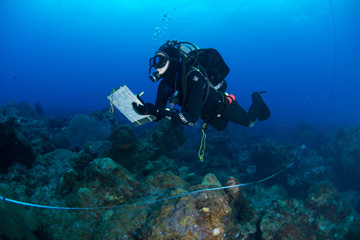
Conducting a fish survey above a transect line.
(Image: FGBNMS/Schmahl)
Lobster & Urchin Surveys
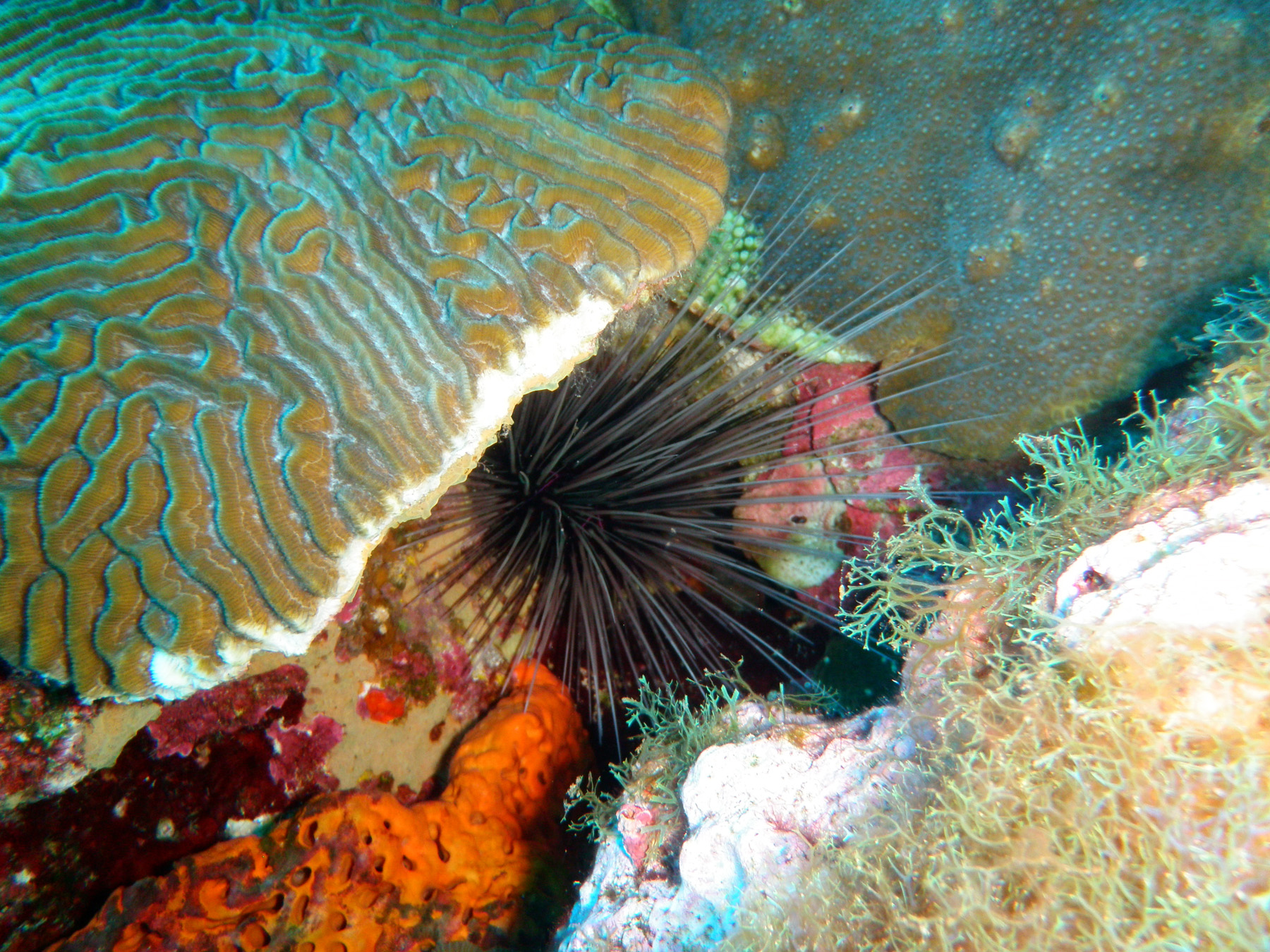
About 1.5 hours after sunset, divers conduct lobster and sea urchin surveys along the perimeter lines of the study site. They note the number of spiny lobsters, slipper lobsters and long-spined urchins that they see.
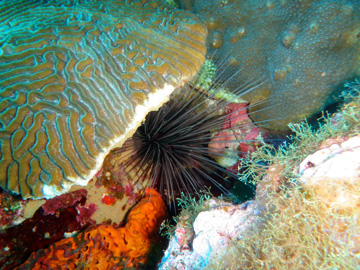
Urchin and lobster counts are conducted along random transects at night. (Image: FGBNMS/Schmahl)
For more information on the use of repetitive photo stations in our monitoring efforts, please visit our Stetson Monitoring page.
top of page
MONITORING HISTORY
The earliest quantitative data on coral and other invertebrate cover at the Flower Garden Banks was collected in 1972 in 27 quadrants, each measuring approximately 12 square meters (Bright and Pequegnat, 1974).
The first regularly collected data on benthic communities occurred in 1978 (Viada, 1980) and continued through 1983 (CSA, 1985). This work was prompted by the drilling activities of Mobil Exploration and Producing U.S., Inc., within 1.7 km of the coral reefs at East Flower Garden Bank.
Minerals Management Service (MMS), now known as Bureau of Ocean Energy Management (BOEM), required that industry sponsor the monitoring program as well as pre- and post-drilling surveys to evaluate the fate and effects of their discharges on the sensitive biological assemblages inhabiting the nearby banks. This involved chemical analysis of sediments taken from the vicinity of the platforms but did not involve biological collections from either of the banks.
Following the completion of the study by CSA in 1983, no new activity was proposed so no further benthic monitoring was conducted at the Flower Garden Banks for nearly 6 years.
In consultation with academia and industry, MMS developed a comprehensive benthic monitoring program for the Flower Garden Banks in the late 1980's. This Long-Term Monitoring program remained in place, with some modifications, from 1988 through 2008.
With the arrival of R/V Manta, a state-of-the-art research vessel, in 2008, it was decided that the sanctuary now had the capabilities to take on the Long-Term Monitoring program itself. In August 2009, the sanctuary completed its first data collection efforts at East and West Flower Garden Banks.
MONITORING LESSON
We have also developed an educational lesson using actual photos from East and West Flower Garden Banks monitoring efforts.
 Download Reef Monitoring Lesson (636kb pdf)
East Flower Garden Bank Images for pin 101 and West Flower Garden Bank Images for pin 501 are available for use with this lesson.
See what other lessons are available by visiting our For Teachers page.
top of page
LONG-TERM MONITORING REPORTS
The most recent long-term monitoring reports for East and West Flower Garden Banks can be found on our Science Reports page.
top of page